
Lafayette Directory Collections by Era
The verified Lafayette city directory run begins with an 1858-59 volume and continues through changing publishers, combined city-county books, telephone books, and later address-order editions. The Indiana State Library publisher inventory and the Tippecanoe County Historical Association guide complement each other. One fixes years and names; the other explains the local shelf, abbreviations, and criss-cross use.
| Collection | Years | Where held | Access |
|---|---|---|---|
| Early Lafayette directories | 1858-59 through 1879-80, with gaps | State Library, TCPL, TCHA | Finding aids, shelf, microfilm |
| Sutton Bros. city and county books | 1882-83, 1885-86, 1887-88 | State Library inventory and local collections | Library or archive research |
| R.L. Polk and later Polk runs | 1896-97 through 2012, with gaps | TCPL, TCHA, State Library | Shelf, microfilm, lookup help |
| TCHA criss-cross directories | 1927-30 and many runs from 1957-2007 | Arganbright Genealogy Center | In-person or staff research |
| Digitized telephone directory | February 1945 | Indiana Memory | Free online item |
Later books may combine Lafayette and West Lafayette. They should not be read as Lafayette-only lists. The runs also contain gaps, so cite the exact volume rather than describing the shelf as continuous.
Lafayette Directory Publishers and Runs
The first listed title is the Lafayette Directory for 1858-59. Bennett editions appear in 1869, 1891, and 1894-95. Burch & Polk issued the 1873-74 book, Swartz a separate 1874 volume, and the Lafayette City Directory covers 1879-80. Sutton Bros. books widen the frame to Lafayette and Tippecanoe County in the 1880s.
R.L. Polk begins a long run in 1896-97, followed by editions for 1899-1900 and most two-year periods through 1911-12. Prairie Farmer's Reliable Directory adds farmers, breeders, and rural county context in 1919. Later Polk volumes include many years from 1921 through 2001 and a 2012 Lafayette-West Lafayette edition. Publisher changes matter because the scope, abbreviations, people included, and order of the book can change with the title.
The State Library directory-year inventory is the right starting list. Check the local catalog or ask staff before traveling, because an inventory proves a known holding, not that every copy is on an open shelf that day.
Read a Lafayette Directory Entry
A Lafayette city directory entry is a publisher's dated snapshot. Early volumes commonly arrange people and businesses by name, often with an address and type of work. Later telephone and criss-cross forms add phone or address-order access. Read the title page and abbreviation key before transcribing a line.
| Name | The listed person or business; spelling can vary by year. |
|---|---|
| Occupation or business | The trade, role, firm, or classified category printed by the publisher. |
| Residence marker | In the 1945 telephone item, “r” marks the residence address. |
| Address | The house number, street, locality, or rural-route form used that year. |
| Telephone | The historical phone tied to the subscriber listing, not a current number. |
Some publishers note a spouse, widowhood, boarding status, or homeownership, but do not assume a mark exists in every run. Copy only what the key for that exact volume defines.
- Criss-cross directory
- An address-order book that turns a street and house number into a listed occupant or telephone.
- Householder index
- An index focused on the person listed for a household, whose scope varies by publisher.
- Abbreviation key
- The volume's own list of shortened terms and local labels. It controls how an entry should be read.
Lafayette's 1945 Telephone Snapshot
The inspected Indiana Memory item is a February 1945 Lafayette telephone directory published by Indiana Associated Telephone Corporation. Its metadata describes subscriber, general, and classified sections. Visible transcript fields include name, occupation or business, the “r” residence marker, residence address, and telephone number. It is one of the clearest online examples of how a historical entry reads.
View the digitized 1945 Lafayette telephone directory alongside the captured item below. The volume can support a name-at-address statement dated to 1945, but it does not prove who owned the parcel.
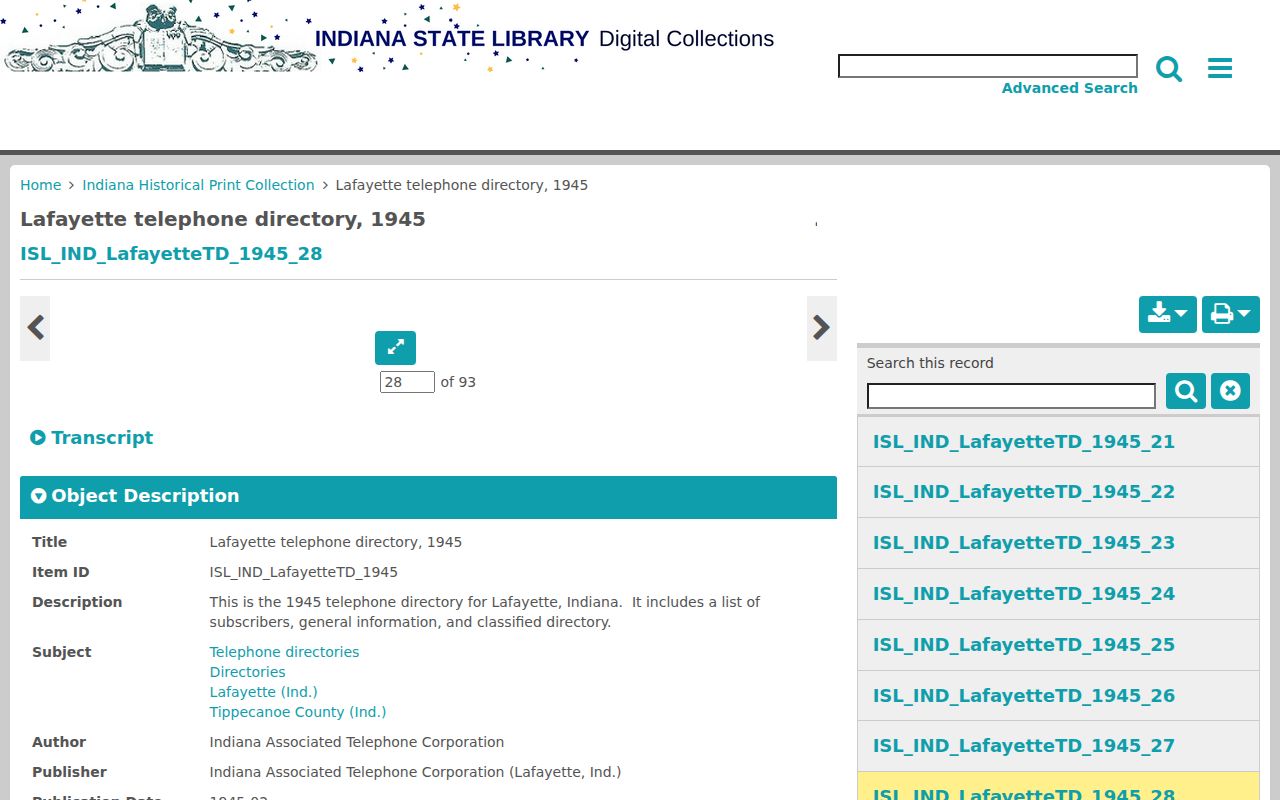
The publisher date is part of the citation. A present-day search should not reuse its phone or address as current contact data.
Lafayette Directories at TCPL
The Tippecanoe County Public Library genealogy collection places city directories beside sources that can confirm a household. Its Family Memory Center and Swezey Room provide local newspapers reaching into the 1850s, census microfilm, cemetery and obituary indexes, yearbooks, marriage material, and local histories. The stated directory and phone-book coverage begins in 1858 and reaches the present with gaps.
Three microfilm machines and printers support on-site work. A ScanPro can send images to a flash drive or email. Ancestry Library Edition is for in-library use, while HeritageQuest has remote access. TCPL also offers lookup help. A remote request should give a full name, date, event, and publication, with a letter and self-addressed stamped envelope sent to Adult Services Genealogy Lookup, TCPL, 627 South Street, Lafayette, IN 47901. The genealogy phone is 765-429-0113.
Two TCPL pages describe different Journal & Courier online spans, one back to 1999 and another as 2006-present. Verify the active database range with staff. The underlying newspaper microfilm remains a useful fallback.
Lafayette Research at Arganbright
The Arganbright Genealogy Center at 1001 South Street holds a research library and archive with the Historical Association's Lafayette city directories. Posted research hours are Thursday 1 to 5 and Friday 10 to 4. The researcher fee is $2, while TCHA and ROAM members are free. Off-site questions can go to 765-476-8411 extension 2 or library@tippecanoehistory.org.
TCHA's archive describes more than 250 business, organization, and personal collections plus a large photo archive. That material can explain an employer, club, building, or street that appears in a directory. Reproduction and licensing fees can apply. The directory guide also warns about gaps and combined Lafayette-West Lafayette geography, so ask for the exact year and title.
Old Names in Lafayette Directories
Historical abbreviations can shift an entry outside the place a modern reader expects. TCHA identifies “Cha” as Chauncey, now West Lafayette, and “Els” as Elston, now Lafayette. Other short forms include Laf, W Laf, Linnwood, Tippecanoe County, rural route, landowner, tax, voter, and criss-cross categories. These are collection labels, not interchangeable current city limits.
Photograph or save the abbreviation key with the entry. Then search both the old label and its current place name. This step is vital for combined city and county volumes, where a surname hit might be several miles from the Lafayette address in question.
Ninth Street Hill adds useful local context. Its history begins with an 1825 plat, followed by large estates in the 1850s and 1860s, streetcar development in the 1880s, a neighborhood association in 1986, and National Register listing in 1997. Those dates help explain why one street can appear differently across maps, city directories, and later neighborhood records.
Trace Lafayette Families by Directory
City directories can bridge the ten-year space between federal census schedules. Lafayette has an added caution: TCPL does not have local 1890 census microfilm, and federal losses make that decade especially dependent on other records. Directory editions near 1890, newspapers, deeds, probate, and marriage or death indexes can replace part of the missing trail.
- Start with a surname, approximate year, street, occupation, organization, or event. Find the first matching alphabetical entry.
- Move one edition at a time. Record every address, spouse or widow notation, business, and change in spelling.
- For later years, use the criss-cross section to test the address and learn who else was listed there.
- Pair directory years with available census schedules, then check newspapers, obituary indexes, cemetery records, deeds, and probate.
- Cite the publisher, year, page, and image. Confirm any key identity or ownership claim with the original custodian.
Disappearance from a volume has several possible causes. The person may have moved, died, changed names, been missed by the publisher, lived outside the edition's scope, or chosen an unlisted phone. An obituary, later deed, nearby directory year, or census entry can separate those paths.
Lafayette Records Beyond Directories
The Indiana State Library Tippecanoe guide maps historical sources that can test a city directory find. It lists Deed Book A for 1826-1830, marriage records and WPA indexes, guardianships, probate material, birth and death indexes, newspapers, maps, and military records.
The captured guide below is the state-level doorway for Lafayette research. It can point to a collection, while the Clerk, Recorder, Health Department, or another custodian may still hold the original or certified record.
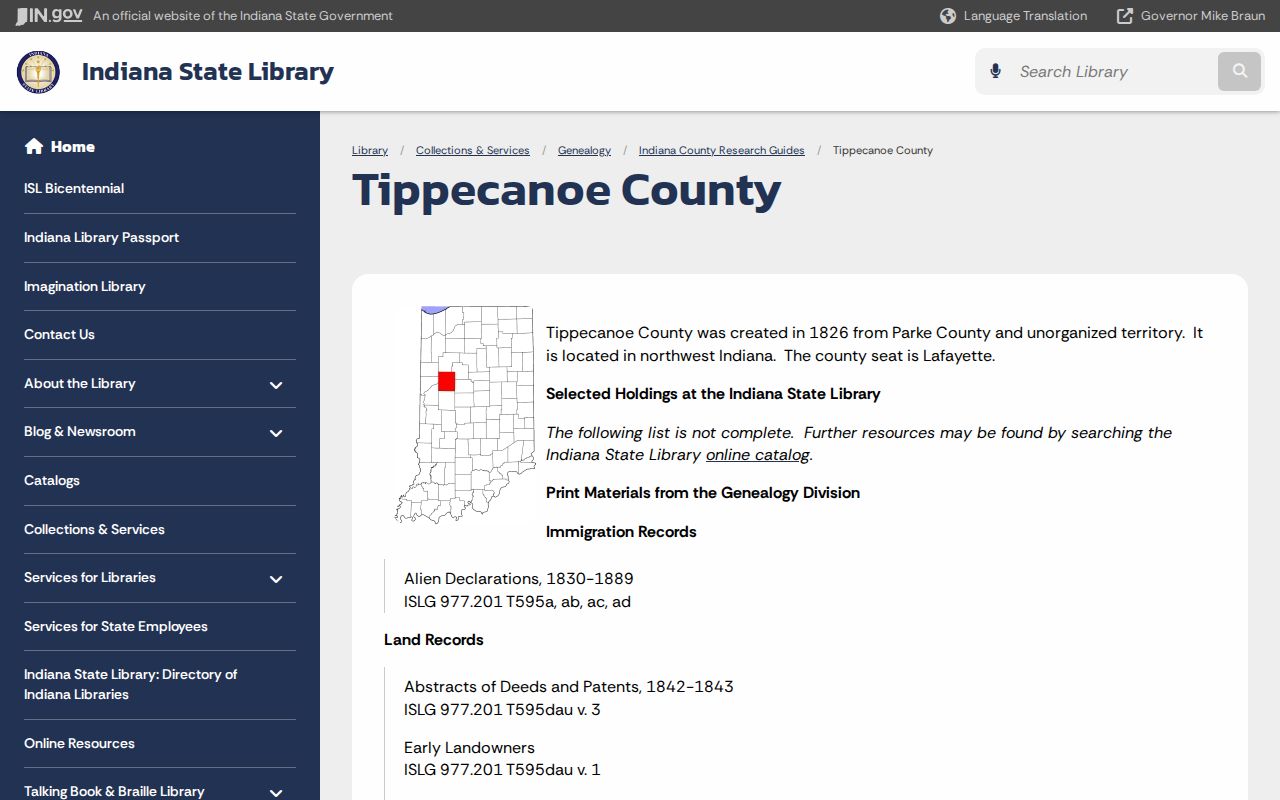
The State Library microfilm inventory lists deed indexes from 1826 to 1901, probate and civil material, wills, and cemetery runs. Because the PDF says it may not be fully current, confirm availability before a visit.
Lafayette Directory Evidence Limits
A city directory proves that a publisher listed a name, role, address, or phone in a certain edition. It does not prove present residence, legal ownership, or a complete household. Early books may omit many people. Later phone books may list only the subscriber. Combined editions can place Lafayette and West Lafayette names in one run.
For a modern address and recorded owner, move to the Lafayette street directory workflow. For a historical claim, retain the page image and then confirm it with a deed, tax record, census, probate file, certificate, or dated newspaper. The strongest conclusion states exactly what the source shows and when.